
You’ve spent months choosing the perfect venue, agonizing over centerpieces, and taste-testing seventeen different cake flavors. But there’s one detail that couples consistently underestimate until it’s almost too late: getting everyone where they need to be, on time, without drama.
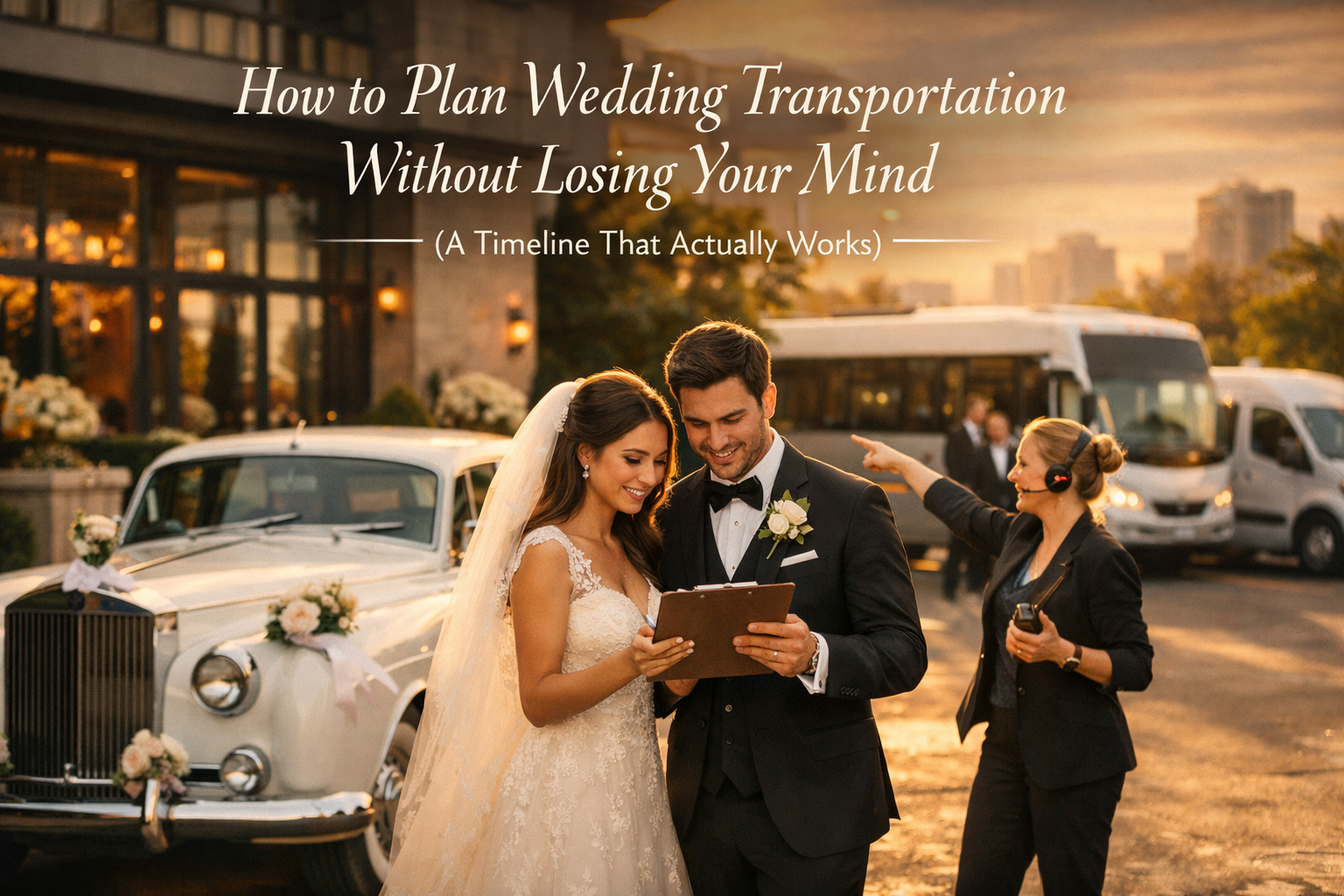
Wedding transportation isn’t just about renting a fancy car for the bride and groom. It’s about coordinating multiple groups of people, each with different needs, all converging on your venues at precisely the right moments. Miss this piece, and you’ll have groomsmen showing up late, grandparents stranded at the ceremony site, and guests getting lost between venues.
Here’s how to handle wedding transportation like someone who’s actually thought this through.
Why Wedding Transportation Planning Matters More Than You Think
Let me paint you a picture of what happens when you don’t plan transportation properly.
Your ceremony starts at 5:00 PM. At 4:55 PM, you’re in your dress, ready to walk down the aisle. But your photographer is missing three bridesmaids who are stuck in traffic because they left late. Your groom’s best man is frantically calling because he’s lost – Google Maps sent him to the wrong entrance. Half your guests haven’t arrived because they’re circling the parking lot with nowhere to park. Your grandmother is sitting in her hotel room, afraid to drive to the venue because she doesn’t know the area and nobody arranged a ride for her.
You’re standing there in your dress, makeup perfect, flowers in hand – and you’re waiting. Stressed. Frustrated. Wondering why nobody’s where they’re supposed to be.
This happens at weddings constantly. Because couples assume that transportation will just “work itself out.” After all, everyone has cars or can call an Uber, right?
Wrong.
Your wedding involves coordinating multiple groups of people who need to be in multiple locations at precise times. Some of these people are elderly. Some are visiting from out of town and don’t know the area. Some will be drinking. Some are in your bridal party and need to arrive early but are staying at different hotels across the city. And some are just regular wedding guests who’ve never been to your venue and don’t know that the GPS directions send them to a locked back gate instead of the main entrance.
Transportation is the invisible infrastructure that makes your wedding day run smoothly. When it works, nobody thinks about it. When it doesn’t work, everyone notices – and it colors the entire day.
The Groups You Didn’t Know You Needed to Think About
The Bridal Party: This one’s obvious, but here’s what’s not obvious – you need separate transportation for bridesmaids and groomsmen. They’re getting ready in different locations, they’re on different timelines, and trying to coordinate one vehicle for both groups is a headache you don’t need on your wedding day.
Parents and Immediate Family: Your parents and grandparents shouldn’t be worried about driving, parking, or navigating unfamiliar venues on your big day. They should arrive relaxed and ready to enjoy the moment. Consider arranging transportation that picks them up from their hotels and handles all the logistics.
Out-of-Town Guests: If you’re hosting guests who’ve traveled for your wedding, they’re staying at hotels without cars or in an unfamiliar city. The ceremony starts at 5:00 PM, but they need to leave their hotel at 4:15 PM to arrive on time. How do they know that? They don’t, unless you tell them – and provide a way to get there.
Many couples arrange shuttle services from main hotel blocks to the venue. It’s not glamorous, but it solves a massive problem. Guests arrive together, on time, and nobody’s frantically calling saying they’re lost on some country road twenty minutes before you walk down the aisle.
The Wedding Party After the Reception: Here’s what nobody tells you – you need a plan for getting drunk bridesmaids and groomsmen back to their hotels safely. You can’t just assume they’ll “figure it out.” They won’t. They’ll try to drive or end up in some questionable rideshare situation, and you’ll spend your wedding night worried instead of celebrating.
The Timeline That Keeps Everything Running Smoothly
Let me give you a realistic timeline for a wedding with a ceremony at 5:00 PM and reception at 6:30 PM.
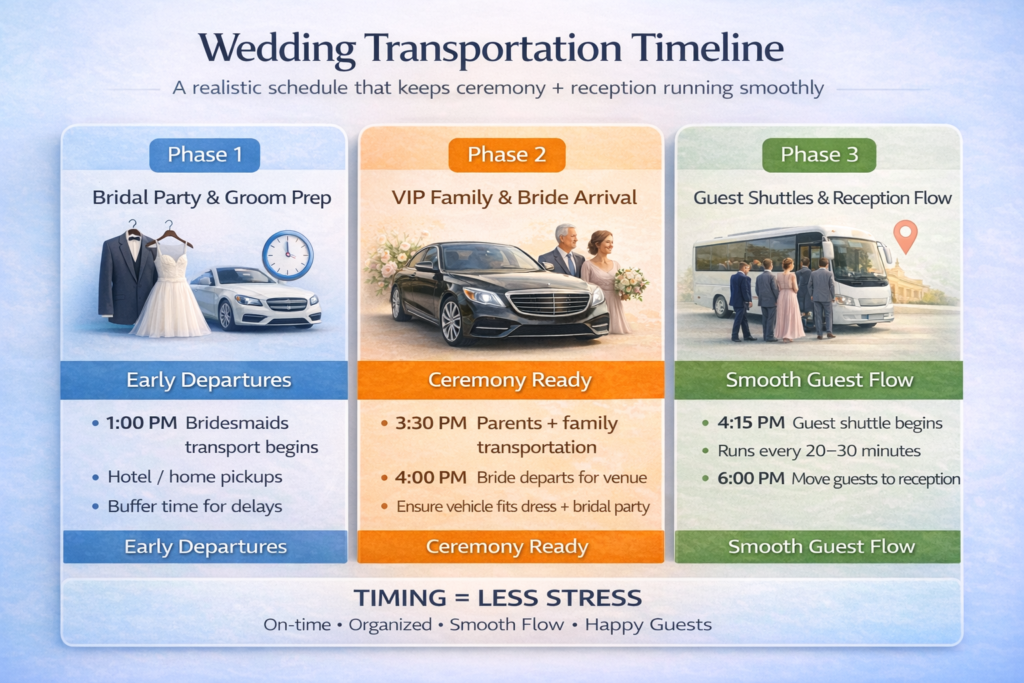
1:00 PM – Bridal Party Transportation Begins
Bridesmaids need to arrive at the getting-ready location (whether that’s a hotel suite, the venue’s bridal suite, or someone’s home). If they’re scattered across different hotels, arrange for a vehicle to do pickups. Don’t make your maid of honor coordinate a carpool on the morning of your wedding.
2:00 PM – Groom’s Party Heads Out
Groomsmen gather at their getting-ready location. Same deal – if they’re coming from different hotels or homes, arrange transportation. Guys are notoriously bad at showing up on time, so build in buffer time.
3:30 PM – Parents and Family Transportation
Parents, grandparents, and any family members who need assistance should be picked up and brought to the ceremony venue. They’re VIPs. Treat their transportation like it matters, because it does.
4:00 PM – Bride Departs for Venue
The bride and her bridesmaids head to the ceremony location. This is where couples usually spring for the luxury vehicle – the classic limo, a vintage car, or whatever fits your style. Just make sure it’s big enough for you, your dress, and whoever’s riding with you. I’ve seen brides trying to squeeze into cars that can’t accommodate their gowns. It’s not cute, it’s stressful.
4:15 PM – Guest Shuttle Begins
If you’re running shuttles from hotel blocks, they should start now, with trips continuing every 20-30 minutes until about 4:45 PM. You want guests arriving with enough time to find their seats, not rushing in as the ceremony starts.
6:00 PM – Transportation to Reception
This is where many couples drop the ball. They plan transportation to the ceremony but forget that everyone now needs to get to the reception. If your reception is at the same venue, great. If not, you need a plan.
At a minimum, arrange transportation for the bridal party, parents, and elderly guests. If possible, continue the guest shuttles. Nothing kills the vibe faster than half your guests getting lost trying to find the reception venue in the dark.
11:00 PM – End of Night Transportation
Schedule shuttles to run from the reception back to main hotel blocks. Start around 10:30 PM and continue until the reception ends, with the last shuttle leaving about 30 minutes after the planned end time (because weddings always run long).
Choosing the Right Vehicles (It’s Not Just About Looking Pretty)
Wedding transportation isn’t just about aesthetics, though that matters too. It’s about functionality, comfort, and making sure vehicles actually work for your specific needs.
For the Bride: The Classic Choice
Most brides want something special for their ceremony arrival. The classic choices are:
Luxury Sedans: Mercedes S-Class, BMW 7 Series, or similar. These work well if it’s just you and maybe your dad or maid of honor. They’re elegant, they photograph beautifully, and they’re comfortable. But they don’t work if you’re trying to transport multiple bridesmaids or if you have a huge dress.
SUVs: Cadillac Escalade, Lincoln Navigator, or luxury SUVs. These offer more space while still maintaining elegance. They’re especially good if you have a big dress or if you want your mom and a couple of bridesmaids riding with you.
Limousines: The traditional choice. A stretch limo can fit your entire bridal party comfortably. They’re iconic and immediately read as “wedding vehicle” in photos. The downside is that they’re sometimes cheesy (depending on your style) and they’re becoming less popular.
Vintage or Classic Cars: A vintage Rolls Royce, a classic Mustang, a restored Cadillac. These are stunning for photos and add unique personality. The catch is they’re not always the most reliable (they’re old cars) and space can be limited. Make sure there’s a backup plan if the vintage car breaks down.
Novelty Transportation: Horse-drawn carriages, vintage buses, even boats if your venue is on the water. These can be incredible if they fit your wedding style, but they’re weather-dependent and sometimes impractical.

Whatever you choose, actually sit in the vehicle before booking it. Bring your dress (or something similar in size) and make sure you can get in and out comfortably. Check that it’s clean, well-maintained, and actually looks like the photos you saw online.
For Larger Groups: Party Buses and Charter Buses
When you need to move your bridal party or groups of guests, party buses and charter buses are your workhorses.
Party Buses: These are exactly what they sound like – buses set up for partying. They typically have bench seating, mood lighting, sound systems, and sometimes even bars. They’re great for bridal parties who want to keep the energy up while traveling. They hold anywhere from 15-40 passengers depending on size.
Party buses work well for:
- Transporting the bridal party if you want everyone together and having fun
- Bachelor/bachelorette party transportation (not wedding day, but related)
- Younger wedding guests who want to treat the ride like part of the party
They don’t work well for:
- Elderly guests who need easier entry/exit
- Professional corporate-type weddings where the vibe is more formal
- Situations where you need quiet conversation or relaxation
Charter Buses: These are regular tour-style buses. They’re comfortable, professional, and efficient. They hold 40-55 passengers. They’re not glamorous, but they’re perfect for guest shuttles.
Charter buses work well for:
- Hotel-to-venue shuttles
- Transporting large groups of guests
- Situations where functionality matters more than style
For VIPs and Executives: Car Service
If you have VIP guests, company executives (for corporate-adjacent weddings), or just want to provide extra special treatment for specific people, individual car service makes sense.
This means luxury sedans or SUVs with professional drivers who provide point-to-point service on demand rather than following a shuttle schedule. It’s more expensive, but it provides flexibility and premium experience.
This is common for:
- Grandparents or elderly relatives who need door-to-door service
- Out-of-town VIP guests who are staying at different hotels
- Parents who want the flexibility to leave at their own schedule
The Questions You Should Ask Before You Book
Don’t just pick a transportation company based on price or availability. Ask the right questions:
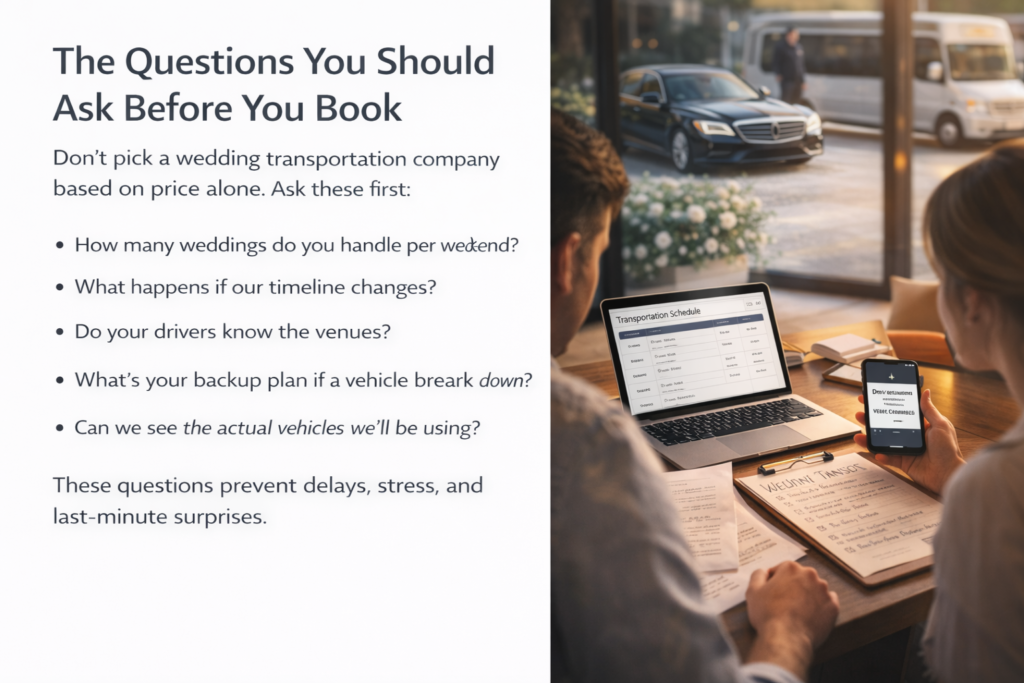
“How many weddings do you handle per weekend?” You want a company that does multiple weddings regularly, not one that’s treating your wedding as a special project they’re figuring out as they go.
“What happens if our timeline changes?” Because it will. Makeup runs long, photos take more time than planned, or the ceremony starts late. You need a company that can adjust without charging you emergency fees or leaving your guests stranded.
“Do your drivers know the venues?” If they’re experienced with weddings, they should know the popular venues in your area – where to drop off, where to park, where to wait. That familiarity prevents delays and confusion.
“What’s your backup plan if a vehicle breaks down?” It happens. You want to hear that they have backup vehicles and can get a replacement to you quickly, not that they’ll try to work something out.
“Can we see the actual vehicles we’ll be using?” Not just photos – the actual vehicles. You want to see that they’re clean, well-maintained, and actually match what’s advertised..
What This Actually Costs
Wedding transportation isn’t cheap, but it’s worth budgeting properly. Here’s realistic pricing:
For the bride and groom’s transportation for a few hours: $200-$600 depending on the vehicle type and your location.
For bridal party transportation (party bus or large vehicle): $100-$150 per hour with minimum rental periods of 4-6 hours.
For guest shuttles: $100-$175 per hour per bus, depending on size.
If you’re looking at a full day of transportation for multiple groups, budget $1,500-$3,000. Yes, that seems like a lot. But compare that to the stress of coordinating everyone’s rides yourself, dealing with parking nightmares, or having important people show up late or not at all.
The Mistakes to Avoid
Don’t assume everyone can drive themselves: They’re going to drink. The venue might have limited parking. Some guests are elderly or unfamiliar with the area. Plan for transportation.
Don’t book transportation last minute: The good companies book up months in advance, especially during peak wedding season (May through October). Three months before your wedding is the right time to book.
Don’t forget about the time between ceremony and reception: That gap where everyone’s transitioning is when people get lost, frustrated, or just confused about what’s happening next. Have a clear plan.
Don’t leave your vendor coordination to the last minute: Your transportation company needs to know the venue addresses, timeline, and any special requirements well before your wedding day. Send them a detailed timeline at least two weeks before the wedding.
Making It All Work Together
Great wedding transportation isn’t about fancy vehicles or expensive packages. It’s about making sure everyone gets where they need to be, when they need to be there, without stress or drama.
Start planning early, think through every group that needs transportation, communicate the plan clearly, and work with professionals who’ve done this before. Your wedding day has enough moving parts without adding “figure out how everyone gets to the venue” to your list of last-minute problems.
When transportation runs smoothly, nobody notices it. And that’s exactly the point. Your guests should be thinking about how beautiful the ceremony was or how fun the reception is – not about how they’re going to get home or whether they’ll make it to the venue on time.
Plan it right from the start, and transportation becomes one less thing to worry about on a day that already has plenty of details demanding your attention.